

Vancouver Noir
Sunset and Jericho

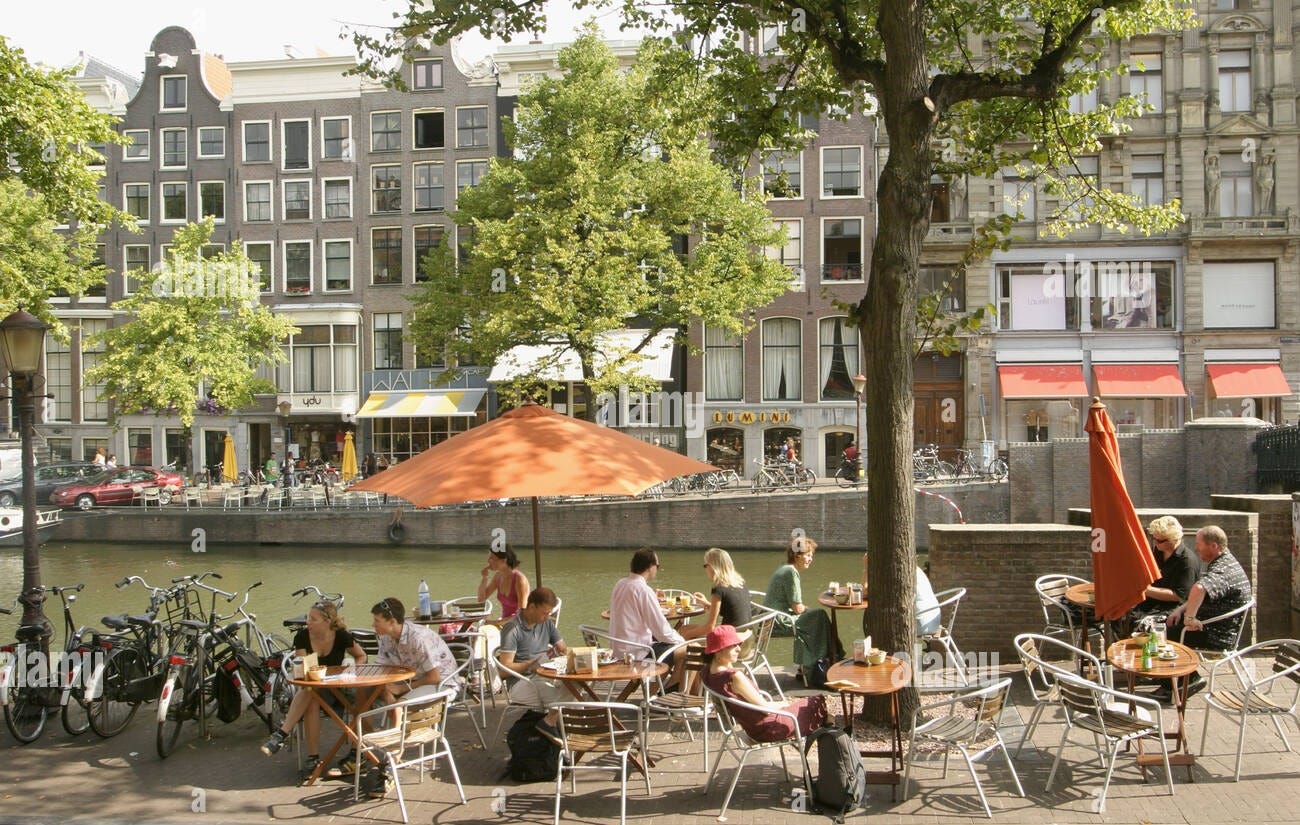
The elm trees at attention like sentries along the canal provide strategic shade from the afternoon summer sun. Sipping a Brouwerij’tij on café patio in Amsterdam I am chatting with a middle-aged Dutch couple about soccer – football to everyone else in the world, soccer to North Americans. The woman asks me where I am from. Vancouver, I lie.
I’ve never lived in Vancouver. I am from Victoria, BC, but very few people east of Winnipeg have any idea where that is, so I just tell them I am from Vancouver.
Vancouver may be known for mountains, seafood, and weed. But it’s famous mostly for the rain and more rain. I am an entrenched Pacific Northwest denizen. The Island is close enough. I know the rain. I am familiar with the rhythm of coastal living; basking in the delight of never-quite-long-enough bright summer days, knowing autumn will descend gradually wringing sun and colour from the landscape in favour of rolling clouds, steady downpours and heavy mists.
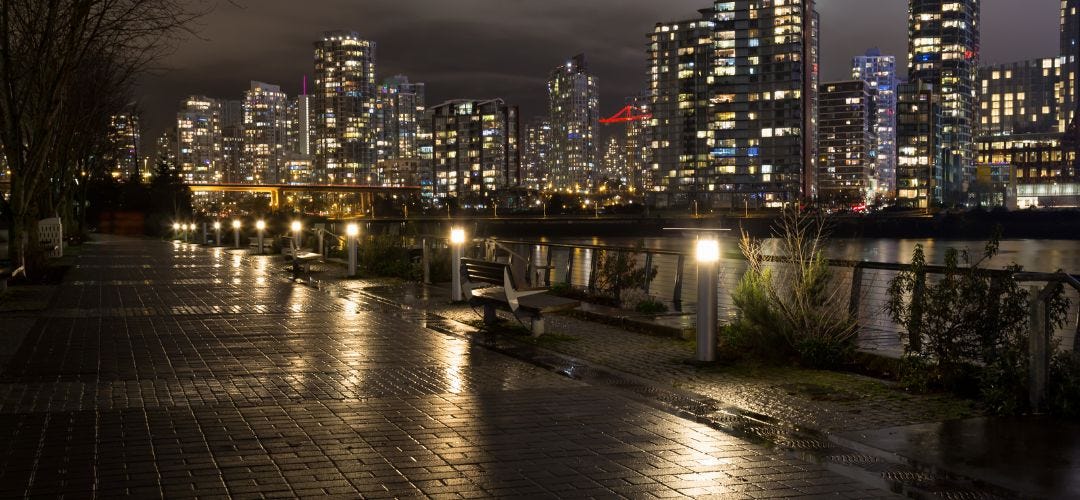
Writers are often warned it is trite or boring to open with a description of the weather. Absurd. Weather shapes more than what we decide to wear in the morning. It forms who we are, our moods, our tones, our sensibilities.
Start with the weather.1 Sunset and Jericho opens, “The view from the mayor’s outer office was something. Pearl-coloured clouds had flung down snow all night, piling slim white barriers atop Vancouver’s roofs and awnings. A late morning rain was undoing the work, drowning Broadway in a slurry of gunmetal, platinum and ash. On Cambie Street, caution lights pulsed. An accident of some sort. It was February, and the wrong people were dying.”
The Pacific Northwest environs both form and capture the temperament of Dave Wakeland, private detective. The mayor of Vancouver hires Wakeland and his more pragmatic partner, Jeff Chen, to find her missing brother. Wakeland uncovers connections to a corrupt wellness guru and an elusive group engaged in urban terrorism calling themselves Death to Kings; a transit officer’s service weapon is stolen. A conspiracy begins to take shape and despite being warned off, Wakeland, against everyone else’s better judgement, plunges deeper into the muck.2
Although I have read a few Elmore Leonard, Dennis Lehane, and a smattering of other detective/crime fiction authors, S.A. Cosby, Ken Breun, Craig Johnson, it is not a genre I often go for. So, take any criticisms with a grain of gunpowder.
In Lydia Davis’s essay Before My Morning Coffee: Learning Dutch, she mentions Maj Sjowall and Per Wahloo’s Swedish detective series was so “innovative [because] they created fully human characters for their police fiction, something we now take for granted, and incorporated political and ethical issues into the stories.”
The social problems that plague modern Vancouver, and most cities and towns across North America are embedded in Sunset and Jericho: wealth disparity, corporate greed, political corruption, addiction, homelessness; a systemic cycle of people preyed upon or disregarded by institutions that could give two-fucks about them.
About halfway thru the book, while I was enjoying the storytelling – part of my delight certainly derived from familiarity of place; a detective who eats at White Spot! Look, he’s drinking a Dark Matter! – I found Wakeland lacking ambiguity. I wanted him to be a little unsavoury, less the hero.3
He doesn’t have to commit heinous acts, murder, rape, assault, but he could have some dubious intentions or motivations. A little greed for money, power or sex. Some ick he attempts to rationalize or is unapologetic for. But that’s not Wakeland. That’s not even the people he is up against in Sunset and Jericho.
The Death to Kings cabal is motivated by a just political ideology that Wakeland cannot dismiss although he finds their methods reprehensible. That’s Wakeland’s conflict, working for the property developers and politicians who stomp across the city with complete disregard for the everyday people trying to eke out a living in it. They aren’t even that bad. They are just disconnected. Out of touch.
Despite a veneer of grittiness Wakeland is a white knight. He’s a dick, to be sure, but his moral and ethical convictions are ironclad virtuousness. He beats up white power douche bags, he gets his disabled, ex-cop buddy a job, he sees injustice in the world and wants to correct it. He’s a good dude. Wakeland possesses a steadfast moral core that will not allow him to condone a takedown of the indifferent elite by any means necessary. He believes in due process and order.
But before the last page I changed my mind. Yeah, I still appreciate a real greasy protagonist venturing into unsound moral territory, or criminality. Even downright ball shivering coldness. But I turned a corner on Wakeland, he felt human, clearly conflicted and damaged. Like the city was asking, ‘You okay?’ And he answered, ‘Naw man. I am pretty fucking far from okay.’
Sunset and Jericho employs all the tropes one expects in detective noir.
Wakeland is a cultured knucklehead, an intelligent bruiser. He’s a reader, and watches Criterion Collection movies with his sister, My Beautiful Launderette, Picnic at Hanging Rock, Kurosawa. It has a music soundtrack of sorts, the bands and singers he listens to are name-dropped, peppered throughout the story with regularity. Same with the books he reads. But he is not opposed to throwing hands so long as the target is, in his estimation, deserving.
Sometimes I find the trademark similes of noir goofy. But perhaps that’s the intention, a sly touch of humour, momentary relief from the murder, betrayal and gunplay. Wiebe deploys them with admirable restraint.4 But enough to pay respect to the genre. Brutish enforcers give as much thought to their victims “as a mother jointing roast chicken for her kids.” A fella gets smacked with a pipe “like knocking a tent peg into sand.”
The Seventy-eight chapters hammer at a breakneck speed. Wiebe’s prose is deliberate and concerted, the pacing precise. It’s plotted with care and contains enough unexpected twists and turns to be continually and delightfully surprising.5 In a Word doc each chapter can’t be more than a half to one and a half pages Calibri 11 point font, I don’t know if this is something I should be impressed by, but fuck it, I am. Because at the end of those seventy-eight chapters despite the brevity and speed, one is left with a feeling of completeness.6
“Don’t talk about the weather. It’s boring.” Bullshit. There’s a whole frigging channel devoted to the thing. When I open my phone the first thing it populates with is time, date and temperature.
Weather’s key to how our day looks: are we going to beach, staying inside? Do need a sweater, rain boots and umbrella. Or are shorts and t-shirt enough? Do I need to rake the leaves? Can I mow the lawn, open a window, walk the dog?
I believe Jonathan Franzen said, weather, the environment, plays such a significant role in who a people are one cannot ignore it. Do not underestimate the influence of weather on forming people’s expectations, worldview and philosophy.
You know what? It might have been Stephen King who wrote that. Fuck me. I can’t remember.
Elizabeth Hardwick’s essay In the Wasteland – on Joan Didion not T.S. Eliot – she critiques the entire Didion catalogue. With glowing positivity, I might add. Hardwick sums up plots eloquently and succinctly. On Didion’s The Last Thing He Wanted she writes, “… Didion has placed a woman, Elena McMahon, on a plane filled with illegal arms bound for Costa Rica, or the off-the-map border installations set up the Americans, the Freedom Fighters. At the end of the flight, she is to collect the million dollars owed her dying father, a man who does “deals.” Collect the money and fly back, or so she has been led to imagine.”
Admirably tight. Can I sum up Sunset and Jericho in a few sentences with equivalent poetry and elan? Hmmm, probably not. But it’s an attempt.
***Can one footnote a footnote? What a giddy feeling finding a writer like Hardwick. After reading the first essay I thought, I am going to enjoy the shit out of everything this lady’s written. I felt compelled to proselytize my incredible discovery. Has anyone else heard of this lady, I want to shout, email friends. Only to be confounded - Yes, everyone has heard of her. Hardwick’s massively well-known and a respected pillar of American letters. Then the next question is: why am I only finding her now? And utterly by chance. On a thrift store bookshelf. What the fuck, people?
Maybe the response to this is: you are reading detective book that revolves around a hero. Literally, the fucking hero. Don’t like it, move on.
Some noir goes hog wild with these. As if the author has done pass and at every fourth or fifth sentence thought, “You know what this needs, a simile.”
A note on my own reading or watching: I am didn’t figured out Bruce Willis was a ghost in the first 20 minutes of The Sixth Sense. I never realized Tyler Durden and the protagonist in Fight Club were the same guy until the last chapter. I didn’t spot that My Year of Rest and Relaxation was going to conclude at 9/11. More astute viewers/readers than myself probably guess all these things at the jump. It used to bother me. I would think, ‘Am I an idiot?’ But it’s just how I prefer to consume the material. I let myself get swept away, caught up in the events, I am not interested in trying to be clever and outfox the author/creators. I want to be surprised, delighted, horrified, shaken, heartbroken or elated by the events of the story. I want to feel them as the character(s) feel them. *I may still be an idiot. That would not surprise me, but at least I am an idiot who’s managed to find acceptance of that.
I should have focused on an the examination of power dynamics in the novel and teased those out. Power dynamics in the relationships, how that power breaks down or how it is built. Everything from the personal (Chen and Wakeland, Wakeland and his ex-cop buddy, etc) and the larger pictures, city hall, The Jericho Centre and their disciples, rich developers in million dollar homes and junkies in SROs. Also I probably should have closed back in the cafe in Amsterdam in a way over-the-top noir voice, “The lady mentioned she had been to Tofino. I corrected myself and confessed I was actually from Victoria. Her face dropped harder than a waiter burning his hand on a cast iron fajita pan. ‘You said you were from Vancouver.’ She threw the words at me hot and angry. ‘No one here knows where Victoria is. I just say I am from Vancouver.’ I protested. A stench drift off the canal like a city garbage strike in it’s sixth week. ‘I know where Victoria is.’ she spat. ‘Not many people do, ma’am. No offence, that’s why I say Vancouver.’ I drained my beer glass and tucked ten Euros under the plastic ashtray. The sun was going down fast and there were at least half dozen more bars calling my name, begging me to forget last ten minutes.’